
Nashvegas is what happens when a city refuses to die and instead sells whatever parts of itself still work.
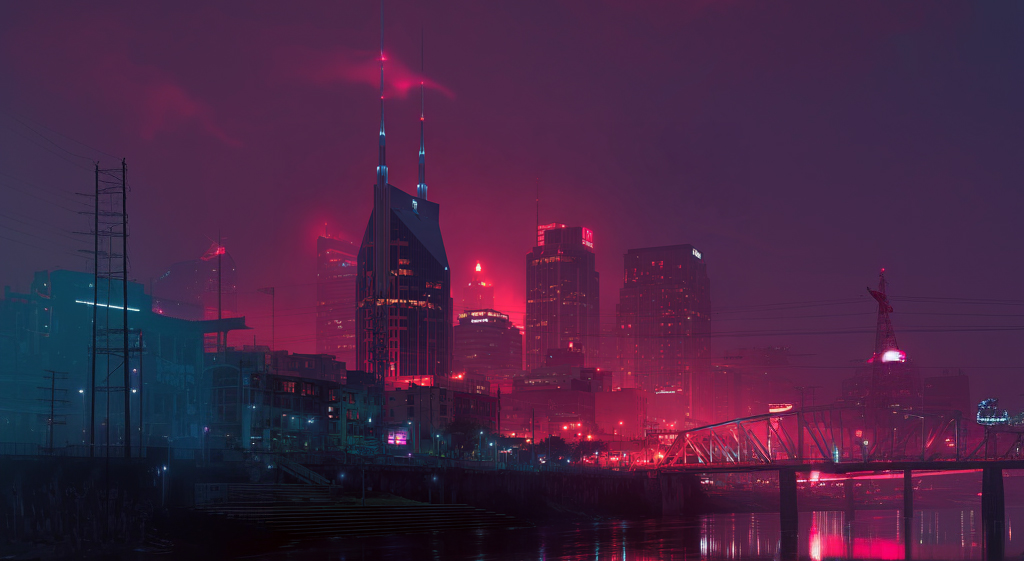
It is built directly on top of old Nashville, both physically and culturally. The bones of the former city are still there, buried beneath chrome towers, neon façades, and entertainment districts engineered to distract. Old streets sit sealed below new ones. Music halls were repurposed into casinos, branded venues, and experience hubs. History was not erased, it was paved over.
The change came after the Reality Wars of 2029.
Official records say the wars destabilized markets, fractured local governments, and left the city scrambling for relevance. Unofficially, people say reality itself bent in places, data went feral, and entire neighborhoods stopped matching the maps. Nashville emerged economically wounded and culturally obsolete. The rebrand to Nashvegas was a gamble in the purest sense.
Gambling was legalized and incentivized. Drugs were deregulated under “personal liberty frameworks.” Firearms became easier to acquire under revised defense statutes meant to “empower local security.” Tourism surged. Money flowed again. For a while, it worked.
Aboveground, Nashvegas is performance. Neon never sleeps. Screens promise indulgence, risk, and reinvention. Corporate districts curate danger just enough to sell it without losing control. Cloning clinics advertise continuity, resurrection, and legacy, but at prices only the wealthy or desperate can afford. Everyone knows someone who came back wrong, missing pieces, or a little out of sync. Nobody talks about it openly.
Outside the city core, the land breaks down into farmlands and abandoned development zones. Fields stretch between rusting server towers, collapsed factories, and decommissioned robotics facilities. Old agricultural drones still roam in places, running outdated routines, harvesting nothing, guarding crops that no longer exist. Scavengers work these areas hard, pulling usable tech from soil that never asked to be part of the future.
Belowground is where Nashvegas actually lives.
The Undercity is a stacked labyrinth of forgotten infrastructure, flooded tunnels, sealed transit lines, and abandoned corporate projects. Entire communities survive below the surface, connected by illegal power taps, black markets, and old tram routes that corporations no longer monitor. Water is filtered, stolen, or traded. Power hums through cables never meant to carry it this long.
The Cumberland presses down on everything. Flooding reshapes the Undercity every year. Some people swear the river remembers what the city used to be.
Corporations still rule Nashvegas, but selectively. Some zones are locked down behind access codes and private enforcement. Others have been written off entirely. Law exists, but only where it is profitable. The rest of the city survives on favors, reputation, and knowing which doors not to open.
Nashvegas is loud, bright, and decaying all at once. It sells freedom while rationing survival. It promises rebirth while burying its past under concrete and light.
And underneath it all, old Nashville is still there, waiting, humming quietly beneath the noise.